Introduction
Providing quality critical care requires skilled healthcare professionals, continuous patient monitoring and timely clinical decisions.
However, small and mid-sized hospitals may face challenges such as limited access to intensivists, increasing ICU workloads and difficulties coordinating critical care across departments.
This is where Tele-ICU services can play an important role.
Tele-ICU, also known as tele-intensive care, uses digital communication and monitoring technologies to connect ICU teams with critical care specialists remotely. Depending on the system, it may support patient monitoring, clinical communication and coordination between healthcare professionals.
With growing interest in digital healthcare, eICU services, virtual ICU systems and remote ICU monitoring are becoming important areas of discussion for hospitals looking to strengthen their critical care capabilities.
In this blog, we explore how Tele-ICU technology works, its potential benefits and the role of trained ICU professionals in delivering effective patient care.
What Are Tele-ICU Services?
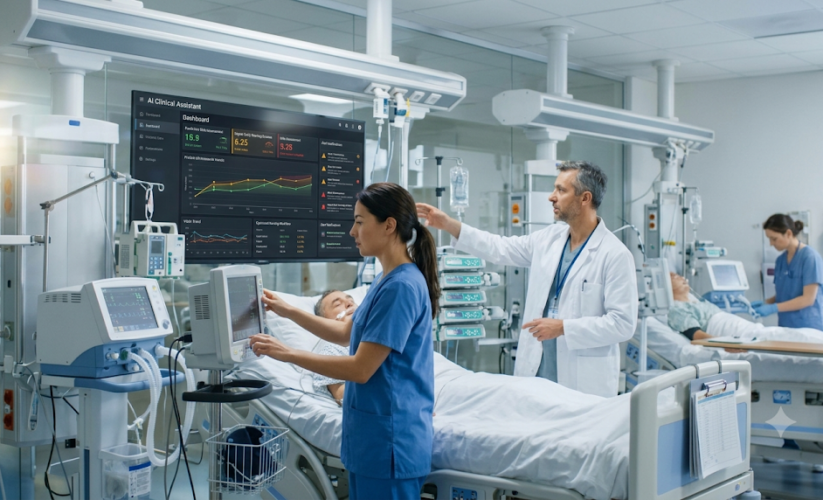
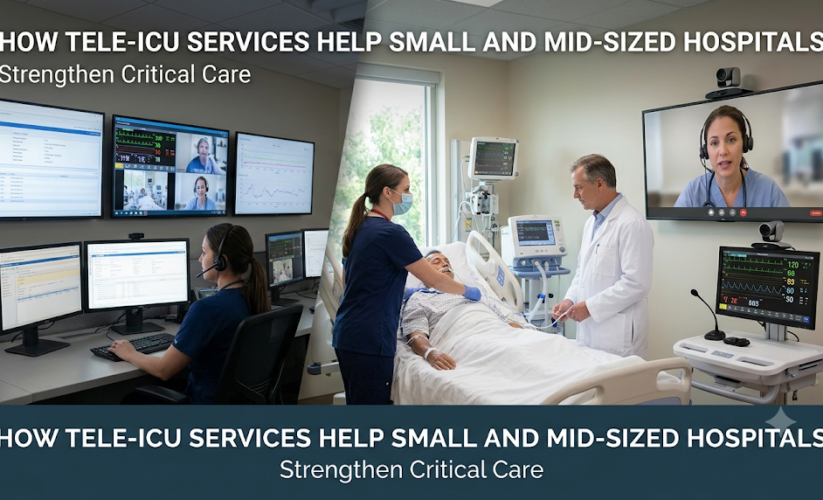
Tele-ICU services use communication technology to support intensive care units through remote access to patient information and clinical collaboration.
A Tele-ICU setup may connect bedside ICU teams with remote critical care specialists through secure digital platforms.
Depending on the hospital’s infrastructure, the system may support:
Remote access to selected patient-monitoring information
Communication between bedside teams and specialists
Review of relevant clinical information
Escalation of changes in a patient’s condition
Coordination of critical care decisions
Support for ICU workflows
The objective is to complement the work of bedside healthcare professionals, not replace them.
Why Do Small and Mid-Sized Hospitals Need Tele-ICU Support?
Hospitals may experience different challenges when managing critically ill patients.
Some common challenges include:
1. Limited Access to Critical Care Specialists
Not every hospital has the same availability of intensivists and experienced critical care professionals.
Tele-ICU arrangements may help connect local ICU teams with remote specialist support, depending on the service model and availability.
2. Increasing ICU Workloads
ICU professionals manage complex patient conditions, monitor clinical changes and coordinate treatment.
Digital systems can support information sharing and communication, helping teams manage their workflows more effectively.
3. Need for Timely Clinical Communication
Changes in a patient’s condition may require prompt communication between nurses, doctors and other members of the care team.
An appropriately designed Tele-ICU system can help support communication and escalation processes.
4. Access to Critical Care Expertise
Hospitals in areas with limited specialist availability may explore remote consultation arrangements to connect their teams with experienced critical care professionals.
The availability and scope of this support depend on the hospital’s clinical arrangements.
How Does Remote ICU Monitoring Work?
Remote ICU monitoring involves using digital systems to make selected patient information available to authorized healthcare professionals outside the bedside ICU environment.
A typical setup may involve:
Patient Monitoring: Bedside equipment collects relevant patient information, such as vital signs.
Data Transmission: Connected systems transmit selected information through secure hospital networks.
Remote Review: Authorized professionals review available information through a monitoring interface.
Clinical Communication: The remote team communicates relevant observations to the bedside team.
Care Coordination: The bedside team evaluates the patient’s condition and takes appropriate clinical action.
The exact process depends on the technology, hospital protocols and clinical responsibilities.
Remote monitoring does not replace bedside assessment or emergency response.
Key Benefits of Tele-ICU Technology
When properly implemented, Tele-ICU technology may offer several benefits for hospitals and critical care teams.
1. Better Access to Specialist Support
Remote collaboration can help connect bedside teams with intensivists and other critical care specialists when such support is available.
2. Improved Communication
Digital communication tools may help healthcare professionals share relevant patient information and coordinate care.
3. Support for Patient Monitoring
Remote access to selected monitoring information can help authorized professionals review patient data without being physically present in the ICU.
4. Improved Clinical Coordination
Tele-ICU systems may support communication between doctors, nurses and other healthcare professionals involved in patient care.
5. Support for Hospitals in Underserved Areas
Hospitals with limited access to certain specialists may explore remote critical care arrangements to strengthen their existing clinical resources.
6. Opportunities for ICU Team Development
Digital critical care systems also highlight the importance of developing skills in patient monitoring, clinical communication and technology-assisted care.
Tele-ICU vs Traditional ICU: Understanding the Difference
Tele-ICU does not replace a traditional ICU. It adds a remote technology-supported layer to the existing critical care environment.
| Traditional ICU | Tele-ICU |
|---|---|
| Care is provided by the bedside team | Remote support may complement bedside care |
| Patient assessment happens physically | Selected patient information can be reviewed remotely |
| Communication takes place through existing hospital systems | Digital tools may support remote communication |
| Requires on-site clinical staff | Requires bedside staff as well as appropriate remote arrangements |
| Physical assessment and intervention are central | Supports remote review and coordination |
Both approaches have important roles in patient care. Tele-ICU is most effective when integrated with established bedside clinical teams and hospital protocols.
What Is the Difference Between Tele-ICU, eICU and Virtual ICU?
These terms are often used in discussions about technology-enabled critical care.
Tele-ICU: A broad term for using telecommunications and digital technology to support intensive care remotely.
eICU: Often refers to an electronic or technology-enabled ICU model that uses connected systems to support remote monitoring and clinical collaboration.
Virtual ICU: A commonly used term for an ICU support environment in which authorized professionals can access selected patient information and communicate remotely.
Although the terms may overlap, their exact meaning can vary between hospitals, technology providers and service models.
What Technology Is Used in ICU Monitoring Services?
Modern ICU monitoring services may use a combination of hardware, software and secure communication systems.
Some commonly used technologies include:
Bedside patient-monitoring devices
Central monitoring stations
Secure hospital networks
Electronic health record systems
Clinical dashboards
Video and communication tools
Data integration systems
Alerts and notification systems
Technology selection should consider patient safety, data security, interoperability, reliability and the hospital’s clinical requirements.
Why Skilled ICU Professionals Remain Essential
Technology can support critical care, but patient outcomes also depend on the knowledge and skills of healthcare professionals.
ICU nurses and doctors need to understand patient monitoring, recognize clinical changes, communicate effectively and respond according to established protocols.
Important skills include:
Understanding vital signs and monitoring parameters
Recognizing early signs of patient deterioration
ECG interpretation
ABG analysis
Ventilator management
Hemodynamic monitoring
Infection prevention
Clinical documentation
Emergency response
Effective communication within the ICU team
As healthcare technology evolves, continuous learning becomes increasingly important for critical care professionals.
Why Skilled ICU Professionals Remain Essential
The growth of ICU telemedicine and remote critical care makes professional training an important part of healthcare development.
Healthcare professionals should be comfortable interpreting clinical information and using monitoring technologies as part of their responsibilities.
Training in areas such as ECG, ABG, ventilation, hemodynamics and patient monitoring can help ICU professionals strengthen their clinical knowledge.
At IntellieICU, healthcare professionals can explore learning opportunities designed around ICU and critical care education.
The goal is to encourage continuous learning, practical knowledge and stronger critical care skills.
Explore ICU learning opportunities at IntellieICU.
Challenges to Consider Before Implementing Tele-ICU Services
Although Tele-ICU technology offers potential advantages, hospitals should consider several factors before implementation.
Infrastructure Requirements
Reliable internet connectivity, compatible devices and secure digital systems are important.
Data Privacy and Security
Patient information must be protected through appropriate access controls, security measures and compliance with applicable regulations.
Staff Training
Doctors, nurses and other professionals need appropriate training to use the systems effectively.
Integration With Existing Workflows
Tele-ICU technology should fit into existing hospital protocols, communication processes and clinical responsibilities.
Clear Clinical Responsibilities
Hospitals should establish clear guidelines about who reviews patient information, communicates concerns and makes clinical decisions.
Successful implementation requires more than technology. It requires trained professionals, suitable infrastructure and well-defined clinical processes.
The Future of Tele-ICU and Remote Critical Care in India
Digital healthcare is creating new opportunities for hospitals to explore technology-supported care models.
In India, discussions around Tele-ICU services, eICU services, virtual ICU systems and remote ICU monitoring are relevant to hospitals seeking to strengthen critical care coordination.
Future developments may include better integration of patient-monitoring systems, improved clinical dashboards, secure data sharing and technology-assisted workflows.
However, technology must be introduced responsibly, with patient safety, clinical oversight and healthcare professional training remaining central priorities.
Strengthen Your ICU Knowledge With IntellieICU
Modern critical care requires a combination of clinical knowledge, practical skills and the ability to adapt to changing healthcare technology.
Whether you are an ICU nurse, doctor or healthcare professional, continuous learning can help you build confidence in critical care concepts and patient monitoring.
IntellieICU supports healthcare education through ICU-focused learning opportunities.
Explore topics such as:
ECG interpretation
ABG analysis
Mechanical ventilation
Hemodynamic monitoring
Critical care fundamentals
ICU patient monitoring
Learn. Practice. Improve.
Visit www.intellieicu.com to explore ICU training programs.
Frequently Asked Questions
Q1. What are Tele-ICU services?
Tele-ICU services use digital communication and monitoring technology to support intensive care teams remotely. They may enable remote review of selected patient information and communication with bedside healthcare professionals.
Q2. What are eICU services?
eICU services generally refer to technology-enabled intensive care arrangements that support remote monitoring, communication and clinical collaboration.
Q3. What is remote ICU monitoring?
Remote ICU monitoring involves accessing selected patient-monitoring information through secure digital systems so authorized healthcare professionals can review it remotely.
Q4. Is a virtual ICU the same as a traditional ICU?
No. A virtual ICU provides remote technology-supported monitoring or collaboration. It does not replace the physical ICU, bedside healthcare professionals or emergency interventions.
Q5. Can Tele-ICU replace ICU doctors and nurses?
No. Tele-ICU is designed to complement bedside healthcare teams. Physical patient assessment, treatment and emergency care remain essential.
Q6. What is the role of an intensivist in Tele-ICU?
An intensivist may review relevant patient information, provide specialist input and communicate with the bedside team, depending on the Tele-ICU arrangement and clinical responsibilities.
Q7. What technology is required for remote ICU monitoring?
A system may require patient-monitoring devices, secure networks, digital dashboards, communication tools and integration with relevant hospital systems.
Q8. Is Tele-ICU useful for small hospitals?
It may help eligible hospitals explore access to remote specialist support and improve clinical communication. Its usefulness depends on infrastructure, staffing, clinical protocols and the service model.
Q9. What skills are important for working in a modern ICU?
Important skills include ECG interpretation, ABG analysis, ventilation, hemodynamic monitoring, patient assessment, clinical communication and emergency response.
Q10. Where can healthcare professionals learn ICU skills?
Healthcare professionals can explore ICU-focused educational programs at IntellieICU.
Related Topics
-
Tele-ICU Services and Their Role in Modern Critical Care
-
ICU Delirium: Causes, Symptoms, Prevention and Management
-
ECG Interpretation for ICU Nurses
-
Understanding ABG Analysis in Critical Care
-
Mechanical Ventilation: Essential Concepts for ICU Professionals
Medical and Educational Disclaimer
This article is intended for general educational purposes only. It does not provide medical advice, diagnosis or treatment recommendations.
Tele-ICU systems and clinical responsibilities vary between hospitals and service providers. Implementation should follow applicable clinical, technical, privacy and regulatory requirements. Patient care decisions must be made by appropriately qualified healthcare professionals.